Survival RPG
HUD & Meter
The interface the whole game runs through — professions, stats, inventory, tools and trade. Free, and nothing else works without it.
Free
Required to play
One moment…
Buying on the site is being switched on carefully, a piece at a time. Everything is available in-world at the Emporium today, and delivery is handled by the bot. Members save on the whole range.
Watch it work
The product tutorial, start to finish.
Read it written up on the forum — the same walkthrough, with the numbers, and somewhere to ask.
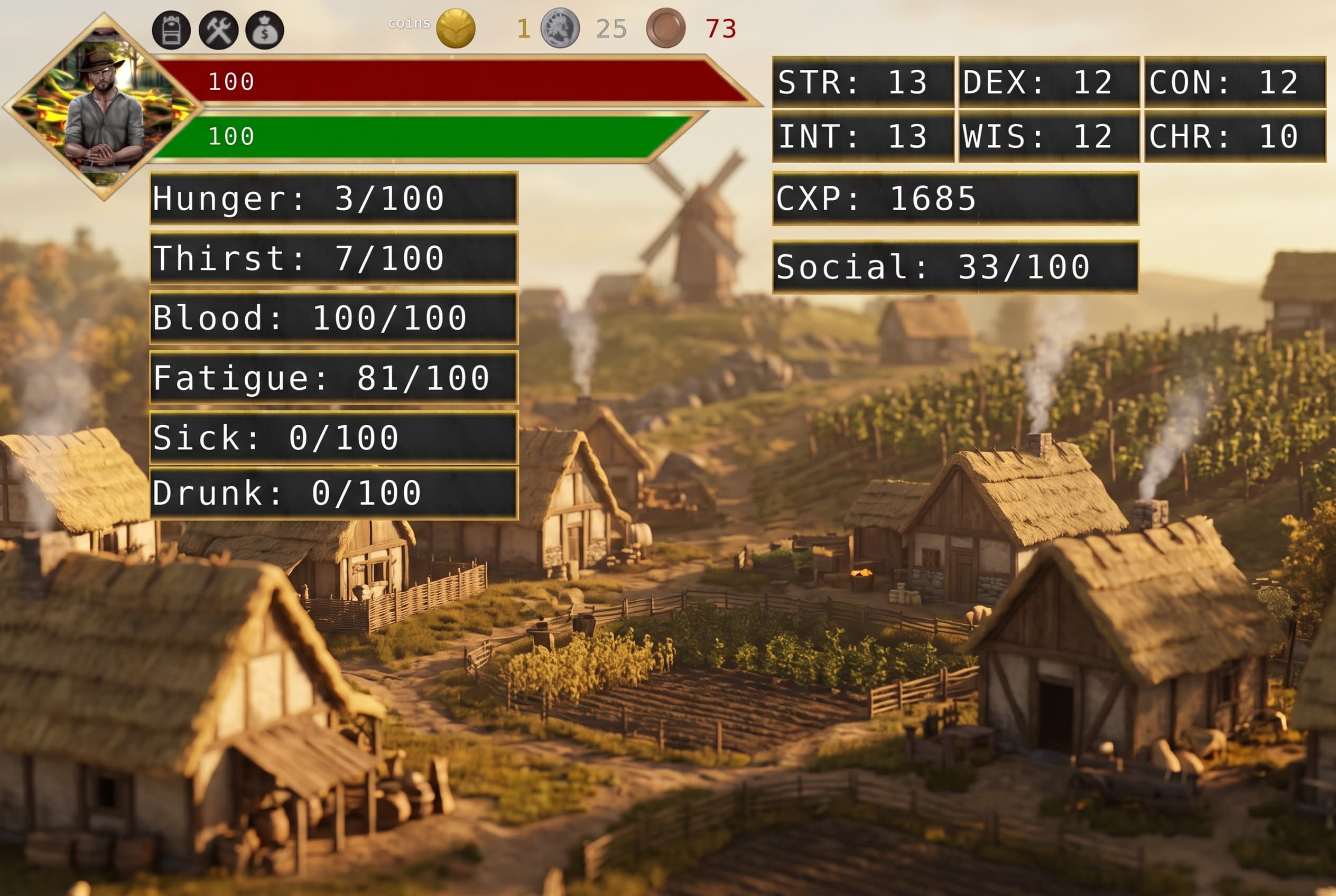
The HUD and the meter are two halves of one thing, and you need both attached. The HUD is the panel top-left of your screen: your inventory, your tools, your coins, and every stat you have. The meter is the floating text above your avatar that other players read. With either one off you cannot gather, craft, or interact with anything in SL Colonies at all.
Staying alive is a real system. Hunger and thirst climb to 100 on their own; once either tops out it starts draining your energy, and when energy reaches zero your health goes with it. Blood sits at 100 until something makes you bleed — lose a single point and it trickles down by itself until you treat it. Sickness comes from eating what you should have cooked. Fatigue is the slow one: it wants sleep, not a meal, so you rest at a campfire or a bed rather than eating your way out of it.
Six stats decide what you are good at. Strength drives melee damage and dexterity drives ranged. Constitution raises the health and blood you can carry. Intelligence and wisdom decide whether you notice a poisoned dish at a feast, and will drive the magic system as it lands. Charisma earns merchants better prices at the marketplace hub and larger rewards from quests.
Crafting experience is the currency of progress. You earn it by working your own profession — a cook earns it cooking — and spend it either at the marketplace hub on seeds, animals, enzymes, yeast and catalysts, or, more usefully, at the levelling station to gain a level and put a point into whichever stat you choose. Changing profession costs it too.
Social points are earned by being somewhere with other people. Click a social stone, stay a while, answer its quizzes, and they accumulate — faster the drunker you are. They are spent before energy on real work, so an evening in a tavern pays for a morning in a field.
Your inventory has an unusual shape. A single stack can be enormous, but hold more than roughly fifty *different* item types and exhaustion starts eating your energy and telling you so in local chat. Storage chests, community chests and trading are how you stay under it. The trade window exists so nobody takes your hundred fish and walks away — both sides commit before either receives.
Tools wear out and the database remembers. Every tool carries a durability counter that ticks down as you use it. Left-click to attach — never right-click and sit, because SL Colonies runs on Second Life experiences. If a tool attaches to the top of your head instead of your hand, that parcel has not enabled the SL Colonies experience. Cleaning the HUD or picking up a fresh one loses nothing: durability lives server-side, and the HUD re-requests your tools automatically.
Three modes worth knowing. PVP only works when both players opt in, and while it is on you cannot hide your health, energy or blood — your opponent has to be able to see what they are doing to you. Tournament mode flattens everyone to base stats so a fight is decided by skill rather than level. Out-of-character stops your stats moving so you can build in peace, but it also stops you gathering and crafting, and coming back out carries a deliberate delay so nobody drops out, flies to a farm, and drops back in.
The meter is yours to style: dark mode for bright regions, any colour for your floating text, and control over exactly which of your name, race, gender, profession, title and colony the rest of the world sees.